Tuesday, September 19, 2023

Sad to be losing 'Winning Time.'

Larry Bird, Red Auerbach, Magic Johnson and Dr. Jerry Buss in "Winning Time."

Yes, I know it was basically pro-Los Angeles Lakers propaganda.

Yes, I know it was highly dramatized and that it played fast and loose with the truth.

Yes, I know that it was intended as entertainment, and not as a documentary.

I still very much enjoyed "Winning Time: The Rise of the Lakers Dynasty" on HBO. And I'm sad that the network I first paid to see as Home Box Office in 1976 has decided to cancel it with so much of the story untold.

HBO has not been kind to my favorite shows of late. Most recently, they decided not to renew the grittier take on "Perry Mason" that was a tour de force for Welsh actor Matthew Rhys (late of "The Americans") in the role that Raymond Burr originated on the late-1950s CBS show of the same name. And now, they've blown up "Winning Time," based on the book by former sportswriter Jeff Pearlman about the emergence of the franchise under the frenetic "Showtime" ownership of Dr. Jerry Buss.

The show got two seasons, but it may have gotten off on the wrong foot right off the bat by changing the name from that of the book -- after all, "Showtime" is the name of a competing, CBS-owned premium cable network. And in many ways, the cable Showtime has been kicking HBO's ass with quality programs for a while now, so the Warner Bros./Discovery empire was not about to give CBS free publicity. 

Kind of like the Lakers and the Celtics. But I digress.

The fictional LA Lakers of 1984
"Winning Time" opened on March 6, 2022, with Earvin "Magic" Johnson (played admirably and endearingly by newcomer Quincy Isaiah) learning for the first time of his HIV diagnosis inside a hospital examination room. That was certainly enough to pull me in from the start -- but little did I know that we'd never revisit that moment despite its importance to the entire Lakers saga because the series would end abruptly on Sunday night. As I said in a social media post, that left an extinction-level crater in the plot for all time.

As the series unfolded, we were introduced to quite a few compelling, if exaggerated, characters -- John C. Reilly (whose gifts as a likeable character actor keep him working steadily) as the flamboyant team owner whose intricate comb-over must have been Donald Trump's inspiration; Jason Segal as the out-of-his-element coach Paul Westhead; Adrien Brody in a steadily more appealing portrayal of player-turned-announcer-turned-coach Pat Riley; Jason Clarke as a foul-mouthed and wound-too-tight Jerry West; DeVaughn Nixon (Laker guard Norm Nixon's son) as his father; Solomon Hughes as the gruff, aging Kareem Abdul-Jabbar; Sean Patrick Small as a surprisingly believable Larry Bird; Michael Chiklis as Red Auerbach (a great villain for this tale if ever there was one); and Hadley Robinson as Jeanie Buss, the owner's daughter, who was starting to emerge as the heir apparent to the Laker legacy before the premature demise of the series ended the storyline.

Jason Clarke as the fictionalized Jerry West.
Almost immediately upon the show's debut, the critics started chirping with their all-too-pious nitpicks over the accuracy of the subject matter. At the top of that list was the portrayal of Jerry West, whose lawyers demanded apologies and retractions regarding the over-the-top portrayal by Clarke as the ex-Laker star and eventual general manager. I've seen more than my share of sportswriters that covered the Lakers -- even the great Bob Ryan, whose coverage of the Celtics of that era is the stuff of legend -- offering testimony that the "real" Jerry West was not the cartoon figure he was portrayed as in "Winning Time."

Well, I'm sure that's so. But once I got the feel of this show, I didn't much care. I wasn't looking for a Ken Burns documentary. I was looking for something to make me laugh and keep me watching -- and listening to the Jerry West character unleashing megaton-level tirades against coaches, players and even Dr. Buss kept me coming back.

Besides, seeing that incorporated into this long, lingering wet kiss to the Lakers of the early 1980s helped me to forget the indignities heaped upon Boston and the Celtics in the name of dramatic license.

Of course, the show portrayed the Celtics and Auerbach as entitled and condescending. Given that the franchise absolutely dominated the NBA in the years before anyone really cared about pro basketball, perhaps it was deserved. It certainly served the narrative.

Yes, I quibbled with the portrayal of Boston basketball fans and all Bostonians in general as racist assholes. That's just too familiar and too easy a stereotype that screenwriters use to set the scene of anything involving Boston. We're either all hoodlums from Charlestown or the bastard sons of Whitey Bulger, and we all speak with the flattest R's and all extend the word "there" to two or three syllables, and I'm just fucking sick of it. By the way, all Italian-Americans are mafioso, as well.

But again, it was just a story. I didn't lose any sleep over it. I may have been more upset that they absolutely blew the rare casting and use of Celtics play-by-play legend Johnny Most during the narrative. Johnny was a unique character in real life, no getting around that, but what "Winning Time" presented was unrecognizable to me.

Sean Patrick Small and Quincy Isaiah as Larry and Magic.
At the same time, I thought as the show progressed into its second season and matured in its narrative, it took great pains to present a more balanced and relatable version of Larry Bird to its Laker-friendly audience. One of the episodes this season compared and contrasted the personal and private lives of Bird and Johnson as they faced both triumph and tragedy on the road to an eventual battle-of-the-titans showdown that they both wanted and needed to legitimize their legacies.

Dyed-in-the-wool Angelinos probably still hated Larry Bird after that episode, but I have to believe they may have respected him more after getting a glimpse of what made him what he was. And even if it was fictionalized, it was still worthwhile to watch.

After two seasons, I really came to appreciate that "Winning Time," while intended to lionize the Lakers of the 1980s, wasn't afraid to show a few warts as well. There was a lot of in-house tension both on the court and off it, and the off-court stories (even if wildly exaggerated) are what fueled my continued interest in the narrative. I particularly enjoyed John C. Reilly's frequent breaking of the fourth wall to converse with viewers about Dr. Buss' occasionally slap-dash motivations. But at the end of the day, learning that the show had been canceled left me feeling like waiting all day to hit the free shrimp at the end of the press box buffet line, only to find they're run out by the time I got there.

The series ended happily for Celtics fans, with Bird & Co. winning the 1984 title and leaving the Lakers to sulk in the old Garden's locker room. (And as an aside, how about that CGI? The old scoreboard, the tiered upper balconies, the banners in the rafters ... they really made it look as if the old Garden had been reconstructed and used for filming the basketball scenes. Kudos!)

But that clearly wasn't where it supposed to end.

Season 3, I'm told, was supposed to be about the Lakers' redemption. But there are other topics I'd have wanted to see. For instance, it's now well-known that Bird and Johnson left their personal animus behind when they filmed a commercial for Converse shoes in the 1984 offseason. They later wrote a book together (with former Globe writer Jackie MacMullan) about the formation and strength of their friendship. Would we have seen that reach the small screen? I also wonder if the show would have reached Dr. Buss' losing battle with lung cancer and the eventual groundbreaking succession of Jeanie Buss as the team's owner.

And of course, there was that opening sequence about Magic's HIV diagnosis. We never will see how "Winning Time" would have treated that.

And that's a damn shame. 

The whole thing may not have been entirely true, but then again, Donald Trump was our president for four miserable years. Truth is indeed stranger than fiction. But at least fiction is still more entertaining.

Friday, September 1, 2023

The Owner's Box, Ep. 49

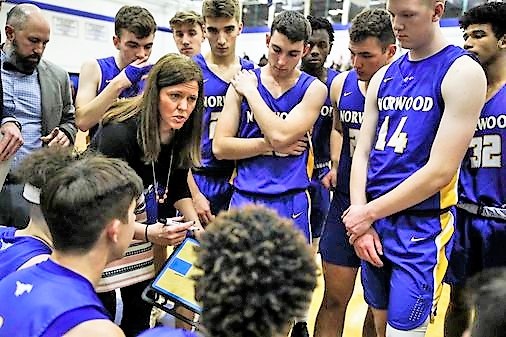
Norwood hoop coach Kristen McDonnell makes her fourth appearance on the podcast.

A good podcast is usually the result of having good guests. So it is for Episode 49 of The Owner's Box, in which I welcomed Norwood High School girls' basketball coach Kristen McDonnell to Fulton Pond Studios (virtually, at least) for her fourth appearance on the show.

It was the first time in 53 months that we've been together on the podcast, so we had a lot to talk about. We discussed her transition back to coaching girls from a successful stint with the boys' team, during which she led Norwood to a state title game. She also explained her innovative summer program of "pickup basketball" for high school girls, and she even offered me a few tips about what to expect if I get a knee replacement.

It's always a pleasure to talk hoops with Kristen, who is as successful and knowledgeable a coach as there is in Massachusetts these days. I hope you'll enjoy listening to it as much as we did recording it.


Tuesday, August 22, 2023

The Owner's Box, Ep. 48

Replacing the ancient scoreboard at right has raised hackles in North Attleboro.

Even the best quarterbacks have to call audibles at times, and thus, the latest episode of The Owner's Box shifted from a guest-driven one to me on my own again. But Episode 48 should be worthy of a listen, as I tackle a multitude of topics -- include the controversial proposal to replace the ancient scoreboard at North Attleboro High's renovated Beaupre Field with a modern video scoreboard.

As you can see in the photo, Beaupre's current scoreboard has been a fixture on the site since the mid-1970s. A new scoreboard with limited video capabilities (and the possibility for advertising to create an additional revenue stream) would cost about $300,000 and is basically already paid for as part of the $5 million appropriation for the overall field and stadium renovation. But as usual, some residents are screaming bloody murder about it because they think it's going to drive their tax bills through the roof -- which it won't.

I also talk about how Robert Kraft will still have to overcome past controversies if he becomes a finalist for Pro Football Hall of Fame enshrinement again next year. And there are other topics in the Lightning Round, so click on the link below to listen.

Originally, my guest for this episode was supposed to be current Norwood High girls' basketball coach Kristen McDonnell, one of the most celebrated coaches in the state. But she had car trouble and we rescheduled the recording session for this Thursday. Unfortunately, because I've practically used up all of my recording allotment on my hosting service for this month, that episode will be posted on Aug. 31.

In the meantime, please enjoy my rants in Episode 48.


Tuesday, August 15, 2023

The Owner's Box, Ep. 47

This big blue A is raising a lot of hackles from the peanut gallery in Attleboro.

Solo flight tonight, but there's a lot of good stuff to talk about. 

We start with a look at the upcoming fall sports schedule for King Philip Regional High School on North TV, with a laser focus on the football games -- I'll be doing seven of eight regular-season KP games including three road games (and yes, I forgot to mention that the North Attleboro crew will be doing the North-KP game late in the season, so that's actually eight of nine, not including the playoffs).

Then I discuss the controversy, or tempest in a teapot, over the big blue letter A that now graces the center of the traffic circle in front of the new Attleboro High.

Patriots fans and media are jumping to record-setting conclusions over one performance against fourth-string Houston Texans talent by rookie QB/WR Malik Cunningham. Is it Malik Mania or Cunningham Colic? You decide.

I also chime in about yet about another date in court for Der Amerikaner Fuehrer, Donald J. Trump, and then I reveal the identity of my next guest on The Owner's Box, coming next week.

I try to keep it lively, so enjoy.

Monday, August 7, 2023

The Owner's Box, Ep. 46.

Foxboro coach Lisa Downs holds the state title trophy aloft at the Tsongas Center.

I told you I was going to start podcasting at an accelerated rate, and I'm a man that lives up to his promises. Here's the 46th episode of The Owner's Box, and the sixth appearance on it by Foxboro High girls' basketball coach Lisa Downs.

Downs' 2022-23 team, of course, won the state Division 2 championship back in March, but we've already talked about that. In fact, just scroll down for a post from April 22 and you'll find the episode of "Around Foxborough" that we did for Foxboro Cable Access as a celebration of that great playoff run.

So instead of rehashing an old topic, Lisa and I talk about various others -- how she has developed such a great rapport with her players (most of whom return for a bid for another title this year), how some important rule changes will affect her team and all of high school basketball in Massachusetts this winter, and her efforts to raise funds for a team trip to Florida in December for a three-game tournament -- among other topics.

Lisa is always a great interview, and we could talk hoops for a lot longer than just the 40 minutes or so we spent at Mass. Premier Courts in Foxboro last week. I hope you will enjoy it as much as she and I enjoyed recording it.


Friday, August 4, 2023

The Owner's Box, Ep. 45

Creating sweet vocal "music" on the keyboard once again.

We're back, baby ... with the first in what I hope will be a regular series of podcasts under a familiar brand.

This time, the second episode of our third season is just me, but it's the first totally recorded on my new computer. I talk about the Northwestern University football hazing scandal (which breaks my heart), the start of Patriots training camp, a summer of joy with my backyard bunnies, the U.S. women's national soccer team in the World Cup, and lots more.

Oh, I also reveal the identity of the guest on next week's episode. I told you I was working on these things again!

Here's a direct link:


Friday, June 2, 2023

Where Mansfield styles began.

Sannie's clothing store in Mansfield in 1975, 40 years after its founding.

My most recent post on this blog elicited a fairly good response from its readers, at least as far as I can tell from the number of looks it got according to the little meter that appears on the left-hand side of the browser version. That was heartening, given that I post a lot less frequently than I used to.

The meter doesn't give me the demographics of the reading audience, but I have to believe they're usually in the 40-70 range, age-wise -- especially when the posts refer to something that hasn't been a part of the Mansfield landscape for more than 30 years.

My last post, if you didn't read it, was about my having to retire a well-worn pair of pants, and how that reminded me of a little two-line classified ad that used to run in the weekly Mansfield News (itself no longer in existence) touting the quality of the pants sold at my father's downtown clothing store.

Over the many years I've been involved in local journalism, I've had the infrequent occasion to mention that store, which closed in 1992, in opinion pieces or other retrospective pieces. The store was named "Sannie's," after the eldest brother of the four sons born to Carmelo and Gandolfa Farinella, formerly of Palermo, Sicily. My uncle, Santino (yes, like Sonny Corleone), left the family bakery and founded the clothing store on North Main Street in 1935, and was gradually joined in the venture by brothers Frank, Tony (my father) and Charlie.

The Wasserman Block in 1955, two years before Sannie's expanded.

Originally just a single storefront in a building originally built in the 1800s as a livery stable, Sannie's gradually expanded to take over a whole series of stores in what was then called the Wasserman Block. First came a small adjacent shop for ladies' wear, then in 1957, a major expansion encompassing the entire Wasserman Block, which was gutted and rebuilt as one large storefront connected to the original building. The store was expanded or reconfigured several more times in the decades that followed, including the purchase of an adjacent bicycle shop that was repurposed as "Sannie's Little World," devoted to infants' and toddlers' wear and other related products.

Inside the pre-1957 Sannie's display area.
The store did a hell of a business for many years -- so well, in fact, that I live comfortably off an inheritance that sustained my mother for 14 years after her husband's death in 2001, and so far, another eight for me after her passing. Sannie's probably would have survived longer than it did if not for changing business conditions brought about by the opening of a local megamall (Emerald Square in North Attleboro) in 1989, and the advancing age of the surviving founding family members.

Strange it is, indeed, to see Emerald Square on the verge of collapse here in 2023 because of the advent and popularity of online shopping.

I guess the secret of Sannie's success during its heyday was that it provided a ready-made clientele what it needed the most -- the basics, every-day goods that met a family's daily needs, not far from home and in a pleasant shopping environment, and at reasonable prices. Sannie's was where you shopped for school clothes, or a good pair of jeans, or underwear or socks, or casual wear for all ages made by companies you knew and trusted.

The four Farinella brothers (Charlie, Frank, Sannie, Tony) in 1958.
The secret to that was some shrewd buying tactics by my father and his brothers. They would scour the wholesalers for big-brand closeouts, styles that were discontinued or about to be, and they'd load up on them and sell them for very attractive prices -- often much less than the big-name retailers such as Jordan Marsh or Filene's. You want Levi's? You could go to the big stores and pay a lot for them, or you could go to Sannie's and not notice the few stitches that weren't in the same place as the newer products and come away with a great pair of jeans and a few extra bucks still in your pocket.

These weren't damaged goods, either. This wasn't a Building 19 or Ocean State Job Lot. These jeans didn't fall off a freight train and then get shipped to an outlet store for quick sale, and let the buyer beware. I wore Izod Lacoste polo shirts from Sannie's that were every bit as good as what was on sale at Jordan Marsh, even if they were no longer current offerings from the manufacturer. Nobody knew the difference.

Hence was the genesis of one of the opportunities for my peers to tease me in my youth, however.

Not long after the opening of the store and the purchase of the original three-story building at 310 North Main Street, my uncle Sannie decided to buy a big neon sign for the store. It was a tall, vertical sign -- an estimated 18 feet in height, maybe a little more -- that spelled out the store's name one letter at a time from top to bottom. At the base of the sign were the words "Wearing Apparel" in neon script, and there was still room enough for one more line of print without the neon, so the brothers chose "Where Mansfield Styles Begin" as the slogan.

At the time of my entering high school in 1968, Mansfield was a town of barely 5,000 residents, and the "Where Mansfield Styles Begin" slogan became somewhat of a joke. The comedians would add, "... and End" to the phrase. Others would note that Mansfield had no style at all (although their mothers would dress them in Sannie's clothing from head to toe). So the saying on the sign was eventually changed to "Your Brand Name Store," which was inoffensive and accurate.

That sign shined brightly in the town for nearly 50 years, even more prominently when it was hoisted onto a pole anchored at the farthest north corner of the expanded store. Indeed, it could be seen from miles away under the right circumstances. On Route 106 heading east from Plainville to Mansfield, there was a higher-elevation point right at the Foxboro town line where at night, you could see the lights of the sign in the distance, probably about two miles away. It was like a welcome-home beacon to me on long nights spent at the newspaper in my early years of employment.

Sadly, a few years ago someone told me that they discovered the rusted remains of that sign in a landfill on Cape Cod. How it got there, no one knows. I had always hoped it would have gone to a neon graveyard like the ones in Las Vegas, but no such luck.

The expanded Sannie's in 1975. The famous ramp is at far right.

Of course, people my age (now teetering upon 70) remember the store quite well. Even my friends with 1970s or 1980s birthdates have memories of the store -- most of them of running up and down the ramp that joined the original building and its higher foundation to the reconstructed Wasserman Block area. As a child, it probably seemed like Mount Everest, but it was good, clean fun -- unless they somehow commandeered a shopping cart and made the downhill run on wheels. My father made many sprints from his office at the back of the store to the base of the ramp to catch would-be Evel Knievels before they collided with display tables or other shoppers.

Portrait of the author as a young man.
I have many fond memories of Sannie's -- not just as a young tyke, but also in my young adult years when I lived next door to it, in an old white house at 8-10 Thomas St. that had been built in the late 1800s by one of the original magnates of the Attleboro jewelry industry, a man named Doliver Spaulding. That giant three-story structure was moved intact in the late 1990s to a new location on Pratt Street, but it served as my home for 14 years under the family's ownership. I parked my car in the store lot at night and often stopped by to chat with my father or to flirt with the store's young female part-time help.

By the way, that old house is on the state's registry of historic buildings -- but unfortunately, not as recognition for my long residence within it.

As close as I was to Sannie's and as fond as I am of my memories of it, I own a distinction not shared by any of my first cousins. Of all of the offspring of the four Farinella brothers, I believe I am the only one among them who never worked at the store in any capacity. When I became of age to look for part-time employment in high school, and with an interest in writing already evident, I got a job writing sports for the local weekly paper.

As I was an only child, I think my father was a little disappointed at first that I had no interest in working at the store. But after he read the first article I wrote for the Mansfield News in the fall of 1968, any disappointment he may have felt quickly disappeared. He was my biggest fan until the day he died, which was on June 9, 2001.

As the photo at the bottom of this post illustrates, Sannie's is now just a fading memory to Mansfieldians. My Uncle Frank retired early due to health issues, then Uncle Sannie died of cancer in 1980. My father and his much-younger brother Charlie continued to labor on for 12 more years, and Charlie's son James came on board toward the end, but times had changed and shoppers were dazzled by the shiny new things opening elsewhere. What had been a staple of Mansfield shoppers for almost seven decades was now an afterthought. The decision was made in April 1992 to close the doors and to sell off everything -- even the shopping carts, one of which sits in my backyard shed.

Demolition of the block begins in 2019.
Upon the store's closing, the property was purchased by a local developer and converted into a mini-mall of sorts, with the spacious interior converted into multiple stores and a diner -- the latter of which seemed to have ventilation problems that caused its patrons' clothing to smell like bacon for hours afterward. Then the entire corner of the block was sold to another developer, and the whole area was leveled in 2019 to make way for a giant apartment complex. We have a lot of those in Mansfield these days, many near the train station along the main Boston-Providence corridor, with more to come. "Location, location, location," as they say.

It does make me wonder what might have happened if my father and his brothers had gone through with plans to purchase a parcel of land at the intersection of US 1 and Route 152 in Plainville before they bought the Wasserman Block, and had moved their store there instead. For a latter-day reference, the lot is where the huge Lowe's is now. Would my family have moved as well? Would I have gone to King Philip Regional High? Would I be even more of a "homer" on my KP sports broadcasts than I already am?

One can only speculate about lives not lived. But every time I drive down North Main Street and see that huge apartment complex at the corner instead of the yellow cinder-block faรงade of the family store, I wonder. Those thoughts also engage when I pull into my driveway, as I managed to save one of those cinder blocks from the wrecking ball in 2019, placing it upon a retaining wall next to my front door.

Yes, we all got good laughs out of "Where Mansfield Styles Begin" and "Pants That Wear." But my family got a good life from it as well, and that's worthy of a lot of respect. I don't mind singing its praise more than 30 years since it became simply another part of Mansfield history.

The new apartment/retail complex where Sannie's once stood.


Saturday, May 27, 2023

Pants that wore!

I'm the guy on the right, and the pants I'm wearing are the stuff of legend.

If you're a resident of Mansfield, Mass., and you're old enough to remember the original weekly newspaper called the Mansfield News, you may recall that among the classified ads, there ran a simple two-line advertisement for a clothing store that read as such:

PANTS THAT WEAR
SANNIES

The ad had been placed in the local weekly from 1936 through the closing of the clothing store in 1991, without change -- even ignoring the typographical error that failed to establish the correct name of the store. It was actually "Sannie's" (please note the apostrophe), so named for the store's founder and my uncle, Santino Farinella. He and his brothers -- Frank, Tony (my dad) and Charlie -- left the bakery business that was founded by their father and went into the clothing and dry goods business, expanding the store from a single storefront in a converted livery stable to a fully-modern department store covering a significant portion of North Main Street at the intersection of Route 106 over the course of nearly 60 years until changing business conditions and attrition of the ownership finally signaled the end of the line.

Sannie, Charlie and Tony Farinella at Sannie's in 1975.
I mention the store and my family ties to it not because of its relevance to this post. It's actually not that relevant, although Sannie's remains relevant to me personally, as the inheritance that sustains me into my old age is directly tied to the thousands (maybe millions) of customers the store attracted over seven decades because it provided them with basic necessities at affordable prices. No, this mention is related more to the marketing scheme that kept that two-line classified ad running in the newspaper long after the newspaper forgot to bill the store for it.

Yesterday, I had to retire a pair of pants. No, I didn't buy them at Sannie's (although I think I still may have a few items of clothing that date back to the early 1990s). But they definitely lived up to the "pants that wear" slogan that was part of the Sannie's legend.

I'm fourth from the left in front, and those are the pants.
They were gray slacks, cotton-polyester blend, 50-inch waist and 30-inch inseam (because I'm chunky), branded "GS" by the retail concern that now calls itself "Destination XL," although I believe it was called "Casual Male" when I bought them. And for the life of me, I can't remember when that was. Cuffs were in when I bought them, if that's a hint. I have photographs of me wearing them as far back as 2010, but they look well-worn already.

I do recall that I bought three pairs of pants on the day that I bought these, and it might have been at the Casual Male store in Dedham, in the strip mall across the street from a Best Buy that used to be the famous Lechmere Sales department store. I bought the same size and style in brown and black, but over the years I wore the gray ones more. They were a match for just about all of the polo shirts I wore, and they were a little more comfortable and forgiving of my belly than the other two.

Over the years, the gray pants showed their age. They became uneven in color, showing it more around seams, the zipper and the belt loops. The fabric became thinner in texture in areas of greatest stress (mostly my butt), growing dangerously close to transparent. And the pockets were becoming frayed and were close to ripping.

But dammit, they still wore well. They were still the go-to pants I needed for casual use, even though I had purchased two new pairs (one black and one Navy blue) about a year ago -- no cuffs, but the same measurements, can you believe it? -- for more formal use. I wasn't planning upon retiring the Old Grays or their brethren just yet.

Thursday morning, I awoke and decided I'd visit my favorite diner for breakfast. I jumped out of bed, asked Alexa for the outdoor temperature to determine the proper weight and weave for the polo shirt of the day, then pulled on the Old Grays. I opted for a lunch menu instead, enjoyed my hot open-faced turkey sandwich, then eventually returned home for an afternoon of contemplating life and nature in my sunny backyard.

It was when I sat down in my brand new Coleman camping chair that I felt something amiss. My right pants leg was a little tighter than normal because I had pulled on a flexible knee brace beforehand to bolster that aching joint, but upon reaching down to make the necessary adjustment, I realized that the entire inseam above the knee had simply blown out.

The threads that held the pants leg together were so stressed and strained from literally decades of service, they had nothing left to give. The end came quickly and mercifully.

I got up, went inside and changed into shorts, and realized sadly that there would be no future life for these pants. Unlike the many polo shirts I have donated to charitable organizations over the years, these were too damaged and too worn out to be of use to anyone else. I folded them, put them in a wastebasket and saluted them for their service.

The two other pairs from that joint purchase are hanging in there, although the black pants have a small separation in the outer seam that may prove catastrophic at some point. The brown pants are in much better condition and may survive even longer.

But the Old Grays were the best of the lot, and now they are gone. If ever a pair of pants was worthy of the two-line slogan of my father's clothing store, those certainly were. They were truly pants that wore.

Saturday, April 22, 2023

Another reason to love girls' basketball, and the art of the interview.

Charlie Rose wannabe (left) interviews the state Division 2 champions.

Recently, I had the opportunity to do something I've always wanted to do. And fortunately, it was right in my wheelhouse, topic-wise, so there were few opportunities for me to screw it up.

I sat down inside the downtown studio of Foxboro Cable Access at the beginning of the month to interview Foxboro High girls' basketball coach Lisa Downs and four of her athletes in the wake of their state Division 2 championship, won last month at the Tsongas Center in Lowell by way of a 73-53 victory over Dracut High. It was for FCA's long-running local talk show, "Around Foxborough," and they asked me to be the guest host because I did the announcing chores for the title game and a few others, I'm known to have some interviewing skills, and I have a a long-standing friendship with Lisa, dating back to her playing days at Foxboro High in the mid-1980s when she was Lisa Garland.

Like I said, that was almost a no-fail situation for me. All I asked in return was that they try to keep the camera off me because Lisa and her athletes were a lot nicer to look at than the elderly whale sitting at one end of the table. Indeed, I was likely to make Brendan Fraser look skinny in his Oscar-winning role by comparison.

But this was also a chance for me to emulate one of my interviewing heroes from back in the day.

Before he got into a lot of trouble at CBS for being too randy with the female employees, Charlie Rose had a long-running interview show at PBS that was really one of the best such shows ever. Rose's laid-back style and thoughtful questions got the best out of his thousands of interview subjects, who hailed from all walks of life.

With a dark background behind him and nothing more than a simple oak roundtable (which Rose himself purchased) between him and the guest, the environment of Rose's shows encouraged an intimate connection between him and his subject. It was very good television -- and a great example to follow for anyone that aspired to be an interviewer of merit.

Unfortunately, while he was hosting CBS This Morning with Norah O'Donnell and Gayle King back in 2017, Rose suddenly faced a host of sexual harassment allegations from almost a 20-year span at the network and other affiliations. It was apparently a shock to Rose's co-hosts, especially future CBS Evening News anchor O'Donnell, who had great chemistry with the veteran interviewer and displayed deep personal disappointment while delivering a statement upon Rose's suspension from the show once the allegations came to light.

That effectively ended Rose's long career. But in my opinion, it does not diminish the quality of the many interviews he conducted over so many years, nor does it lessen one's desire to emulate his skill.

So imagine my inner joy when I walked into the FCA studio and found a black cloth backdrop behind where I was sitting. It was my chance to channel my inner Charlie Rose -- just without the sexual harassment part.

I think I did a pretty good job with the interview, but it helps to know the subject matter as well as I did. The real stars, however, were Coach Downs and her athletes -- Cam Collins, Maddie Maher, Erin Foley and Izzy Chamberlin -- as they recapped the joys of the season-long quest for the title and the happy by-play that took place along the way. You may particularly enjoy the story, recapped by Erin Foley, of why they chose to buy a hot pink suit for their coach to wear during one of their tournament games.

Here's a link to the interview, thanks to Foxboro Cable Access. And please, pay no attention to the big fellow seated to the left of the table. The coach and her athletes were the real stars of the day.

Wednesday, April 19, 2023

Once again, the case for Bill Parcells.

Bill Parcells is on the ballot again.
I have been a member of the New England Patriots Hall of Fame Nomination Committee for 17 years now. I have attended all but one of the annual meetings; the only time I was prevented from attending was when I was trapped at the office of The Sun Chronicle, putting the final touches on a 16-page broadsheet supplement containing all of the winter-season all-star teams, and I simply didn't have the time to get away.

And when I look around, I'm shocked to realize that I am one of a dying breed (no pun intended) of original members of the committee. Indeed, five of the original 27 members from the 2007 meeting have passed on. At this year's meeting earlier this month, only 11 of the originals were still in attendance.

But younger reporters from 2007 have become veterans by 2023, and we all have one thing in common.

Apparently, we all want Bill Parcells to be a member of the Patriots Hall of Fame.

The former head coach from 1993-96, Parcells has been on the three-name ballot chosen by the committee in 2011, 2012, 2014, 2020 and now again in 2023. In his four previous appearances, he was beaten out by Drew Bledsoe, Troy Brown, Ty Law and Richard Seymour, so it's tough to say he was unfairly denied membership by inferior candidates. 

This year, from about maybe 10 names put into the hat, the committee selected Parcells, Logan Mankins and Mike Vrabel -- the latter, while certainly a deserving candidate, has failed to earn the red jacket in six straight ballot appearances prior to this year.

For sure, we've all heard the admonitions. "Parcells was trying to get out of town the whole week before Super Bowl XXXI," the refrain goes. "He bailed on the team! He didn't even fly home with his team! And he went to the Jets and then he stole Curtis Martin!"

That is repeated so often, on chat-room message boards, in podcasts and on sports-talk radio, that Patriots' media relations czar Stacey James has to remind us every year at the beginning of the meeting that we should not refrain from voting for someone just because we don't think he can win. It should be merit-based and nothing else.

I'm not supposed to write specifics about the discussions, but I will tell you that Parcells was nominated early in the meeting. I spoke during the discussion because at least half of the committee members weren't involved in the coverage or management of the team when interim owner James Busch Orthwein hired Parcells as head coach prior to the 1993 season.

Remember, my coverage of the team dated back to Chuck Fairbanks' tenure. Experience and history should serve for something, I thought. 

So I asked my fellow committee members to forget the .500-ish record of the team during his tenure here, to forget the events of the week of Super Bowl XXXI in New Orleans and his controversial departure, and anything that transpired after that.

I asked them to either remember or envision what the New England Patriots were in the months prior to the Tuna's arrival. They were, in a word, a mess.

Victor Kiam liked the razor, but ruined the Patriots.
Owner Victor Kiam, the driving force (and TV spokesman) behind the Remington electric razor company, was teetering on the brink of total bankruptcy in the wake of his thoroughly inept stewardship of the team. He had tried unsuccessfully to sell the team to Reebok chairman Paul Fireman and had brought in a financial advisor named Fran Murray who was supposed to smooth the course toward new ownership, only to have that devolve into a steaming heap of failure.

At the same time, a new stadium (then to be called the Trans World Dome) was under construction in St. Louis, which had just lost the Cardinals franchise to Phoenix. A group of investors, desperate to get the NFL back in St. Louis, convinced the NFL to name one of their own as the interim owner of the Patriots with the intention of moving them to the banks of the Mississippi.

Hence came Orthwein, heir to the Anheuser-Busch beer fortune. A reserved and thoughtful man that was uncomfortable in the presence of the aggressive New England media, Orthwein had one job -- to smooth over the chaos that the Patriots had become and to prepare them for their transformation into the St. Louis Stallions within a year's time. Indeed, once the NFL put Orthwein in charge, the folks back in St. Louis started cranking our souvenir memorabilia for the Stallions -- some of which can be seen today on display inside the Patriots Hall of Fame.

James Busch Orthwein
Orthwein's first job was to find a head coach. Dick MacPherson, an affable soul that had gained football fame through his many successful years as head coach at Syracuse University, had just been fired after two roller-coaster seasons with the Patriots -- the last of which included a raging case of diverticulitis that forced him to miss several games.

There wasn't a nicer guy to be found than Coach Mac, and he did manage to get his first team to a 6-10 record. His on-field enthusiasm was the genesis for a series of car commercials in which the catch phrase "No hugging!" poked good-natured fun at his penchant for emotional displays. But in the NFL, he was clearly overmatched and undersupported by his front office.

Here's where Orthwein did something that should almost rate his own membership in the Patriots Hall of Fame.

Parcells had left his post as head coach of the New York Giants as a result of heart problems in 1990, not long after the Giants beat the Bills in Super Bowl XXV. His "retirement" included time in the NBC television booth and brief flirtations with the Tampa Bay Buccaneers and Green Bay Packers. But in 1992, Orthwein offered him the job to resurrect a 2-14 team not only on the field, but off it as well. Although he was not to officially carry the title of general manager, Parcells had the task of straightening out the corporate structure of the team from soup to nuts, and to get it functioning as well as his championship teams in New York had -- no doubt, with the goal in mind of having a smooth-running operation ready to hit the ground running when the transfer to St. Louis was made.

Parcells' moves were swift. He cleared the roster of deadheads and malcontents, and anyone he thought would not adapt willingly to a much more structured and disciplined football operation. So it was also with a bloated front office filled with warring factions from the Sullivan and Kiam ownership eras. The chain of command became uncluttered and straightforward -- it was truly Bill's way, or the highway.

Meanwhile, Patriots' fans that were in denial about the looming St. Louis threat reacted positively and hopefully to having a "real" head coach for the Patriots. They set a franchise record for season-ticket sales in the first few days following Parcells' hiring, and suddenly a stadium that had trouble attracting 15,000 fans at some points in the recent past was going to be close to full going forward.

The Parcells presser was like a football classroom.
Parcells found assistant coaches that mirrored his philosophy. He stocked the roster with former Giants that still had something left to give (mostly leadership), or players that fit a specific mold that included toughness, intelligence and commitment to detail. And with the No. 1 pick in the draft, he got Drew Bledsoe -- and say what you want about him in the wake of Tom Brady's career, Bledsoe was clearly the best QB the Patriot ever had to that point. 

The first year was a struggle, but all the parts seemed to come together toward the last third of the season when the Patriots ripped off four straight wins. The last of those was an overtime victory over Miami at Foxboro Stadium before more than 55,000 fans, the crowd swelled by the knowledge that it might be the last pro football game ever played in the Boston area.

As I told my fellow committee members, I remembered standing in the parking lot behind the press box side of the stadium as I headed to my car, my post-game interviews having been conducted. But I soon realized that a majority of those 55,000 fans had stayed in the stadium, cheering and chanting and basically pleading Orthwein not to take this suddenly interesting team away from them. It was surreal, and the first real evidence that with the right pieces in place, Boston and New England could become prime pro football territory.

That was the impact of Bill Parcells. Yes, he got them to the playoffs the next year (where the Patriots lost to the Bill Belichick-coached Cleveland Browns in the first round), and then two years after that, had them in the Super Bowl.

Yes, it ended badly. Yes, he left in a huff, looking to shop for his own groceries. But let's not think about that for a second.

Back at that season-ending game against Miami, the cheering fans had reason to fear that the Patriots might indeed be headed out of town. But what they didn't know was that in the months leading up to that, Orthwein and his lawyers learned to their horror that the 20-year-old lease that bound the Patriots to play at Foxboro Stadium was almost impossible to break without having to pay a seven-figure penalty, maybe even more. Whatever the final total would have been, it was something that Orthwein and his St. Louis partners were both unwilling and unable to accept.

Orthwein gives Kraft the keys in 1994.
At that point, Orthwein moved swiftly toward Plan B -- to find local ownership for the Patriots and hope the NFL would reward him and his native city in an upcoming round of expansion. Waiting in the wings was Robert Kraft, who already had part-ownership of the stadium after being awarded it in a sealed-bid bankruptcy auction. A long-time season-ticket holder who ran a very successful paper products empire, Kraft bit the bullet and offered the sum of $168 million for the team. By late January 1994, the team was his -- and stability was finally on the horizon.

For years, Kraft complained that he "overpaid" for the Patriots. But now that he's worth more than $5 billion -- and Dan Snyder's pending sale of the Washington Commanders may set the next sale price for a franchise at $7 billion -- Kraft has very little to complain about.

But would the team had been as attractive if Parcells had not been the head coach? I'd guess probably not.

Over the years, the canyon that opened between Kraft and Parcells appears to have become unbreachable. Even though both men, now in their early 80s, have expressed regrets over how things unfolded at the end, fans have elevated the schism to mythical proportions. It's as if Parcells guided a Soviet invasion force to the beaches of Cape Cod and burned down everything in their path all the way to East Rutherford, N.J.

Especially the "He didn't fly home with the team!!!" part. A lot of coaches often travel on their own. I know from personal experience that Bill Belichick was not on the team plane after Super Bowls 36, 38, 39, 49 and 51 because he stayed behind to accept the Lombardi Trophy from Roger Goodell at the day-after MVP pressers.

OK, different circumstance, I know. I also know that Parcells liked to drive that big, black Cadillac sedan of his to and from the games at the Meadowlands every year because the drive relaxed him -- just as he would lock his office at the stadium after each season ended and point that Caddy toward Jupiter, Fla. Making a big deal out of Parcells' travel habits is sheer nonsense. The truth is that two powerful men that were extremely comfortable in leadership positions had far too much trouble finding common ground for them to continue working together.

It happens. I wish they could have found that common ground and not have subjected us to Pete Carroll for three years thereafter, but that's history and it can't be rewritten.

Still, for all that Parcells accomplished and despite what he couldn't, he did lay the groundwork for the Patriots' successful future. Belichick lost his job in Cleveland just before the Browns moved to Baltimore to become the Ravens, but Parcells brought his former long-time assistant to the Patriots' staff in 1996 as the secondary coach (and de facto defensive coordinator). Not only did that benefit the team on the field immediately, it also brought Kraft and Belichick together to forge a friendship that would culminate in Belichick's hiring as the head coach in 2000.

Those that hate Parcells for his departure will probably not be swayed. But their vitriol is polluting the minds of younger fans, early 30s and younger, who cannot remember from personal experience what the Patriots were before they became a dynasty. I see it as my job to bring historical fact to this argument.

So please, fans, go to Patriots.com and vote for Bill Parcells to be in the Patriots Hall of Fame, and we can all move on. If you don't do it, we'll keep putting him on the ballot year after year after year -- or maybe, eventually, old farts like me will finally convince Kraft to put Parcells in the Patriots Hall of Fame as a "contributor" -- an honor that the owner rightfully bestowed upon long-time assistant coach Dante Scarnecchia at our last meeting.

Please, just do it. Parcells is in the Pro Football Hall of Fame. It makes no sense that he's not in this team's hall of fame as well.

DISCLAIMER: At this point, I have to admit that I did not put Parcells in the top position on my ballot this year. The three-name ballot assigns five points to the top spot, three points to the second and one point to the third individual, and the total number of points determines the ranking that results in three finalists.

I had actually put wide receiver Wes Welker's name in nomination and spoke to how I believe he took the slot receiver position and redefined it for himself and everyone else that followed. Discussion about him was very positive, so I assumed that I had done my job and put forth a worthy candidate.

On my ballot, I put down offensive guard Logan Mankins as my first choice (as I had the previous year; he was a true warrior, strong and silent in the Gary Cooper mold, and one of the best linemen they ever had).Welker was my second choice, and then I stopped and pondered the words of Stacey James about how I shouldn't make my choices because of the alleged electability of the candidate. 

So, Bill Parcells made it to my ballot again.

I just wish you fans will think about it as much as I did. Even a few seconds of thought is better than none at all.